In a written reply to a question in Lok Sabha, Minister of State for External Affairs V Muraleedharan gave a brief account of the four-month-long standoff and said the Chinese side attempted to transgress the Line of Actual in several areas of the western sector since mid-May.

'After winning the World Cup and not being able to go to Barca, it was time to go to the US league to experience football in a different way and enjoy the day-to-day.'
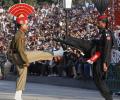
'Pakistan's capacity to carry a normal relationship with India doesn't exist.' 'The relationship with Pakistan is less important than several others.'
The Shiromani Akali Dal-Sanyukt will contest on 17 seats.
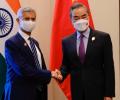
External Affairs Minister S Jaishankar on Thursday conveyed to his Chinese counterpart Wang Yi the need for an early resolution of all outstanding issues along the Line of Actual Control in eastern Ladakh, and asserted that bilateral ties should be based on mutual respect, mutual sensitivity and mutual interest.

Chinese Foreign Minister Wang Yi arrived in India Thursday evening in the highest-level visit between the two countries after the ties came under severe strain following the eastern Ladakh standoff nearly two years ago.

'Both sides should, therefore, focus on easing tensions in the friction areas by refraining from any actions that may lead to an escalation in the situation'

India and China on Friday held 'in-depth' discussions on addressing the remaining issues along the Line of Actual Control (LAC) in eastern Ladakh, holding that disengagement in the North and South banks of Pangong lake provided a good basis to work towards their early resolution.

He said that "the state of the border will determine the state of the relationship, that's natural".

The agreement provides for extensive cooperation in the civil nuclear energy sector including in research and development for peaceful uses of nuclear energy, they said.

External Affairs Minister S Jaishankar is set to hold separate bilateral talks with his Chinese counterpart Qin Gang and Russia's Sergey Lavrov at a beach resort in Goa on Thursday on the sidelines of a conclave of the Shanghai Cooperation Organisation (SCO) amid rapidly evolving regional security situation.
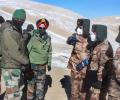
In the fresh round of talks, the Indian side is expected to press for disengagement of troops as soon as possible in all the remaining friction points besides seeking resolution of issues in Depsang Bulge and Demchok.
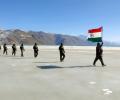
India has told China not to "shift goalposts" and "confuse" managing the border affairs and restoring peace at the frontiers with the larger issue of the resolution of the boundary question, which is dealt with by different designated mechanisms.

On the backdrop of surgical strike, the US advised caution given the heavy militarisation between the two neighbours.

On Tuesday, the dharmasabha started on a heated note first over seating arrangements, and then on other issues, including taunts aimed at each other, they said.

This is a challenge India's political establishment will have to face unitedly, without looking for electoral benefit, warns Vir Sanghvi.

'And (the prime minister does so) without giving any hint of a recognition of the political violence resulting in the ethnic cleansing (of tribals and Kukis) which he simply equates it with atrocities against women in other parts of India.' 'This is not acceptable.'

"We value our partnership with India, and we've been increasing it and doing a lot more, over time. They have the same security challenge, primary security challenger that we do, and it's real on their northern border," Admiral John Christopher Aquilino, commander of United States Indo-Pacific Command, told members of the House Armed Services Committee during a hearing on Indo-Pacific National Security Challenges.

India on Monday said there was 'no scope for misunderstanding or misrepresenting' its position
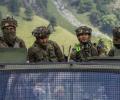
Two days after the India-China military talks, the joint statement, issued in New Delhi by the Indian Army said both sides had a 'candid and in-depth exchange' relating to disengagement along the Line of Actual Control (LAC) in the Western Sector of India-China border areas.

The septuagenarian leader has with this victory, broken the record of veteran leader SC Jamir, who helmed the northeastern state thrice.
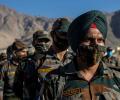
India on Thursday said that ensuring a comprehensive disengagement of troops in all the friction areas in eastern Ladakh is the 'immediate task', remarks that came ahead of another round of military talks with China on the border standoff.
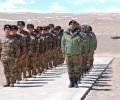
The two sides agreed that the next round of military dialogue should be held at an early date.
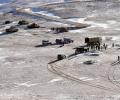
The MEA said the two sides agreed to continue discussions through diplomatic and military channels to resolve the remaining issues "at the earliest" so as to create conditions for the restoration of normalcy in the bilateral relations.

The agreement provides for creation of an enabling framework for closer cooperation and interoperability, besides allowing militaries of the two countries to use each other's bases and facilities for repair and replenishment of supplies, the official said.

Singh's comments that the nuclear option should not be resorted to is a message to Russia as well as Western powers backing Ukraine, people familiar with the matter said. Ukraine does not have any nuclear arsenal.
The last contact between India and China was the military talks at the Corps Commander level in October this year.
"The meeting thus did not result in resolution of the remaining areas," the Army said in a statement.

The government declared NSCN-K, all its front organisations and formations as a terrorist organization under the Unlawful Activities (Prevention) Act, 1967, a home ministry spokesman said.
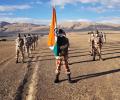
India and China on Friday agreed to hold the next round of military talks at an early date to achieve the objective of complete disengagement in remaining friction points in eastern Ladakh amid fresh sparring between the two sides on the prolonged Line of Actual Control (LAC) standoff.

After 18 years of war, the US and the Taliban signed the peace deal in Doha on Saturday to facilitate intra-Afghan dialogue in Oslo this month and the withdrawal of all foreign forces from Afghanistan in 14 months.

India on Monday joined a US-led initiative to set up an Indo-Pacific Economic Framework to bind partner countries to achieve common goals, with Prime Minister Narendra Modi asserting that New Delhi will work with the stakeholders to make it an "inclusive and flexible" structure to pave the way for development, peace and prosperity in the region.
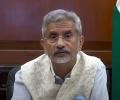
"Discussions are on; what is going on is something confidential between us and the Chinese," he said when the moderator at the Bloomberg India Economic Forum pressed the minister to give a clear status of the border situation.

Ehsanullah Ehsan said that he will release a detailed statement later in which he will mention the agreement he made with the Pakistani security authorities.

'Wang Yi said the border issue is important and we should stay committed to peacefully addressing it through consultation and coordination.'
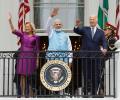
The constitution of both countries begins with the "three words -- We the People -- as President Biden just mentioned", said Modi, who is on his first state visit to the US.
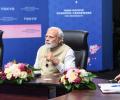
As US President Joe Biden launched a new trade deal with 12 Indo-Pacific nations, including India, to enhance trade, economic and investment opportunities, China, which sees the pact as a threat to its dominance in the region, went on the offensive against it, promising more opening up, while the official media here termed it as "economic Nato".
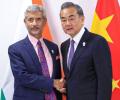
The joint statement said Jaishankar and Wang agreed that both sides should take guidance from the series of consensus reached between leaders of the two countries on developing India-China relations, including not allowing differences to become disputes.
